

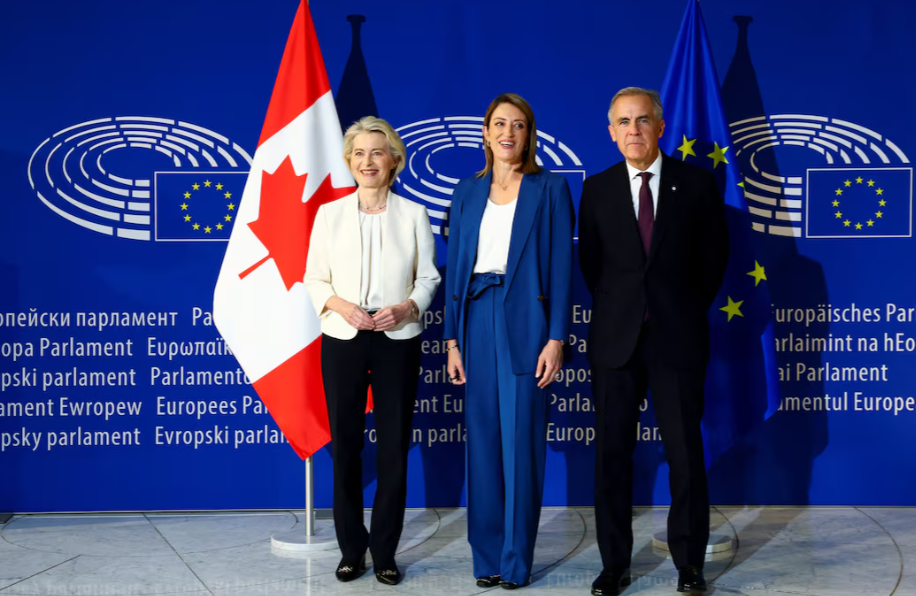
On September 16, 2026, European Commission President Ursula von der Leyen used her State of the Union address in Strasbourg to invite Canada to become the European Union’s first “associate member.” Canadian Prime Minister Mark Carney sat in the front row as guest of honor. The chamber gave him a standing ovation.
Von der Leyen framed the offer as an “Alliance for the Future” built on the existing CETA trade deal: deeper work on manufacturing, technology, AI, defense industrial bases, energy, critical minerals, batteries, the Arctic, quantum, cyber, and economic security. She said Europe and Canada “see the world with the same eyes” and that the partnership is “not against anyone else, but for our common strength.”
The status does not exist in the EU treaties. Capitals were caught off guard. Diplomats immediately flagged clashes over steel, autos, genetically modified crops, “Made in Canada” preferences, and alcohol rules. Any real membership would require treaty change; that is not on the table.
The timing is not subtle. Canada is locked in a bitter tariff war with the United States. Carney has been shopping for a “unique alliance” with Brussels while simultaneously reopening military channels with Beijing.
The China file
On September 4, Canadian and Chinese defense officials held their first “defense coordination dialogue” in eight years. Beijing announced it. Ottawa confirmed a working-level meeting and repeated that “guardrails” remain—specifically that defense is not an area for deeper cooperation. Critics noted the optics: the same government that once called China Canada’s greatest security threat is now sitting down with the PLA while trade talks with Washington have collapsed.
That combination—EU political alignment plus a thaw with China’s military—does not look like a Five Eyes or NORAD asset from Washington’s perspective. It looks like hedging that cuts against U.S. national-security priorities under President Trump: supply-chain security, critical minerals, Arctic presence, and keeping China at arm’s length in North America.
An EU-Canada defense industrial integration and a proposed European Security Council that includes Canada, the UK, Norway, and Ukraine would give Ottawa an alternative security conversation. It does not replace NORAD or U.S. nuclear extended deterrence. It does give Carney a political story that Canada is not isolated.
Manufacturing is already walking
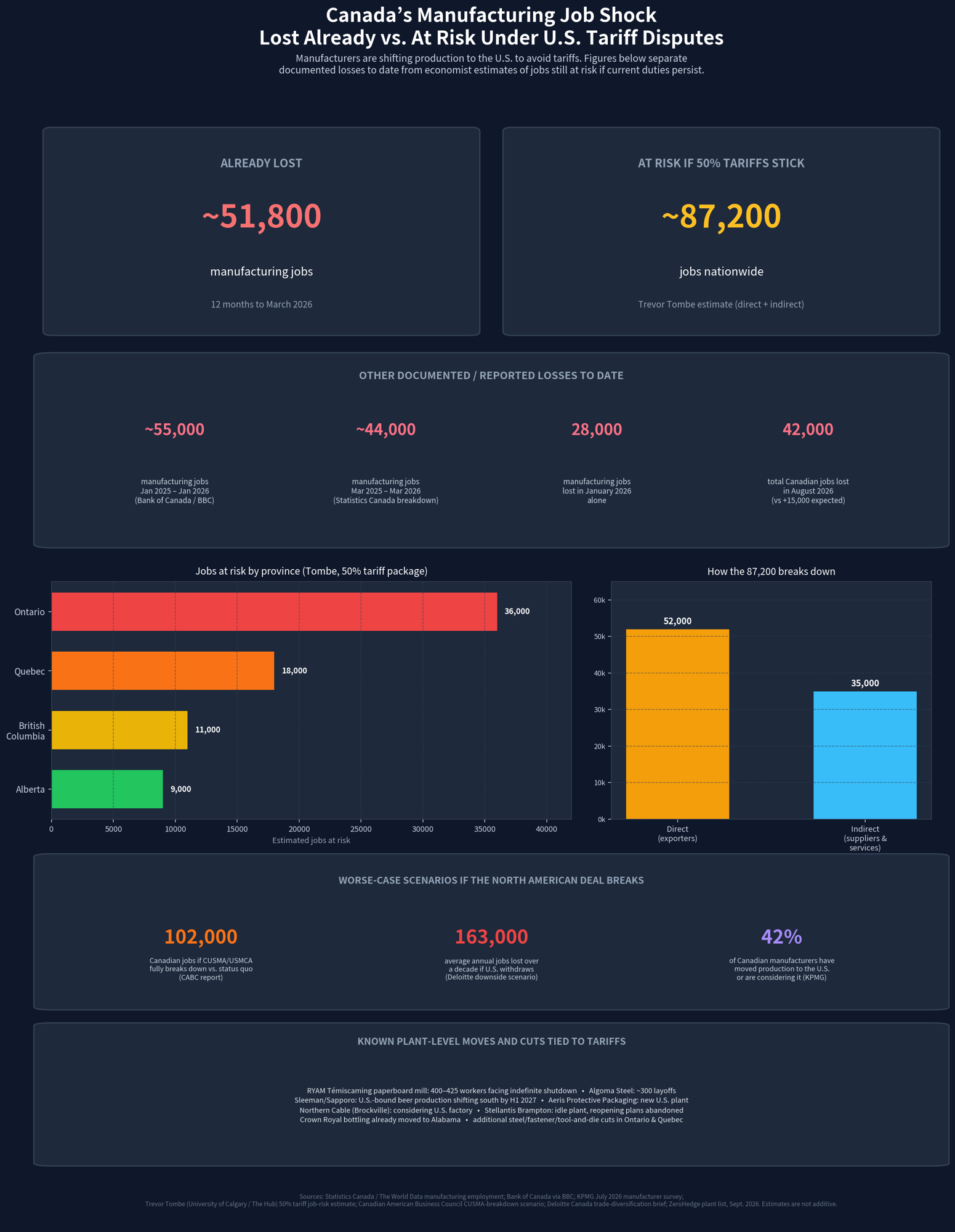
The ZeroHedge report on manufacturers leaving Canada is not theory. A KPMG survey found 42 percent of Canadian manufacturers have already moved some production to the United States or are considering it; 29 percent have already moved some or all. Fifty-seven percent have paused or cut capital spending.
Concrete cases: Aeris Protective Packaging opening a U.S. plant; Sleeman/Sapporo shifting U.S.-bound beer production south by the first half of 2027; RYAM’s Témiscaming paperboard mill facing an indefinite shutdown affecting 400-plus workers; Stellantis weighing the fate of the idle Brampton assembly plant; Northern Cable looking at a U.S. factory. Crown Royal bottling already moved to Alabama.
Manufacturing has already shed more than 51,000 jobs in the twelve months after the first wave of tariffs, concentrated in Ontario’s auto and steel corridor. Economist Trevor Tombe estimates the newer 50 percent U.S. tariffs on selected Canadian goods put roughly 87,000 Canadian jobs at risk—52,000 direct and 35,000 in supplier and service sectors. Ontario would take the largest hit (~36,000), then Quebec (~18,000), B.C. (~11,000), and Alberta (~9,000) even though Alberta’s direct export exposure to the new tariff list is modest. A Canadian American Business Council scenario of a full CUSMA breakdown projected 102,000 Canadian job losses versus status quo.
Canada sends about 78 percent of its exports to the United States. There is no EU or China market large enough, close enough, or integrated enough to replace that in a few years. CETA already exists. Trade with Europe has grown, but it is not a substitute for the U.S. auto, steel, energy, and parts complex.
Carney has accused the United States of violating CUSMA/USMCA with successive tariff waves. Washington has its own list of Canadian practices it considers discriminatory—dairy, alcohol, autos, cultural protections, and third-country deals. Both sides walked away from a near-deal in late August. Canada’s retaliation took effect in September. The legal process under Chapter 31 was not completed before the tit-for-tat escalated. That is the core of the “violated signed trade agreements” charge from both capitals.
Alberta is already on the ballot
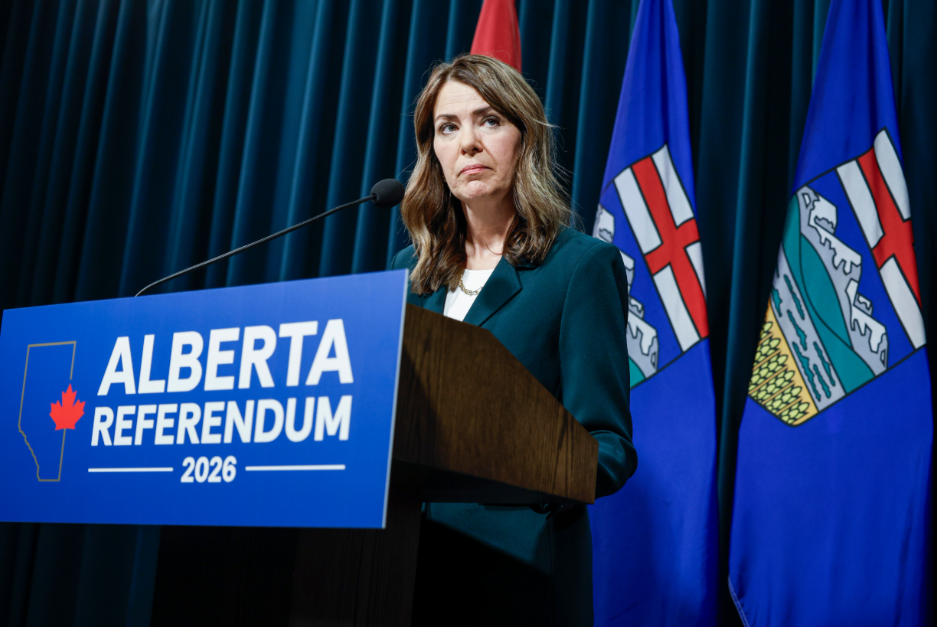
Alberta does not need this crisis to put independence “on the ballot.” The October 19, 2026 referendum already includes the question: remain a province of Canada, or instruct the provincial government to start the legal process for a later binding separation vote.theglobeandmail.com
Recent polls show a clear majority for remaining: Abacus Data (Sept. 4–7) had 64 percent remain and 24 percent “commence the process”; Research Co. had 74–22. A vote to commence is not a vote to leave. Follow-up questions suggest only about 18 percent of Albertans would actually vote to separate if a binding question arrived. Rural Alberta is closer. UCP voters are split.
A prolonged manufacturing slump, higher unemployment, and a federal government visibly pivoting to Brussels and Beijing while energy-producing Alberta watches Ottawa’s climate and trade posture would not need to flip the majority to change the political temperature. It would raise the “send Ottawa a message” share and keep the second-referendum option alive into 2027. Energy and fiscal transfers are the long-running grievance. A tariff war that hits Ontario factories while Ottawa courts the EU’s regulatory orbit is gasoline on that fire.
Does this help Trump’s national-security reset?
Partly yes, partly no.
Yes: a Canada that is economically weaker, more dependent on distant partners, and politically noisy about “sovereignty” is less able to free-ride on U.S. continental defense while criticizing U.S. trade policy. Manufacturing that relocates to the United States is, from a Trump administration view, onshoring. Pressure on Ottawa to choose between the U.S. market and a China thaw is consistent with economic-security doctrine.
No: NORAD, intelligence sharing, and Arctic awareness still matter. A Canada that treats the PLA as a dialogue partner while seeking associate status with a European project that itself is building “independence” from Washington complicates the northern flank. An EU-Canada defense industrial track that tries to substitute for U.S. systems is exactly the kind of parallel architecture the Pentagon’s Europe posture review is already forcing on NATO Europe.
Would the United States pull out of NATO, and what happens to Europe?
A formal Article 13 withdrawal is not the current policy. What is happening is conventional retrenchment: fewer fighters and tankers allocated to NATO, canceled long-range fires deployments, troop reductions from Germany, a six-month Europe posture review, and explicit language that Europe must take primary responsibility for its conventional defense. Analysts call it NATO 3.0 or decoupling.
The United States accounts for roughly $1.03 trillion of NATO’s projected $1.81 trillion in 2026 defense spending—about 57 percent. That is national defense spending, not a check written to Brussels. The common NATO budget is about €5.3 billion; the U.S. share is 14.9 percent, on the order of $750–800 million. “Redirecting NATO spending” therefore does not free a trillion dollars. It frees force posture, munitions, ISR, tankers, and political attention for the Indo-Pacific and homeland. That is the point of the review.
Europe’s loss would not be mainly infantry. It would be the alliance’s eyes and ears: intelligence, surveillance, reconnaissance, aerial refueling, strategic airlift, command-and-control architecture, and the credibility of the U.S. nuclear umbrella. France and the UK have independent deterrents; they are not sized or postured as a continental umbrella. European spending has risen sharply—Germany’s budget in particular—but mass, interoperability, and “fight tonight” readiness still lag. A 2029 horizon for replacing U.S. conventional enablers is the optimistic planning case. A crisis before then would expose the gaps.
Canada as an associate EU defense partner does not fill those gaps. It adds a politically convenient extra flag.
GDP and the realignment that will not pencil out quickly
IMF-linked 2026 figures put U.S. nominal GDP near $32.4 trillion, the EU near $23.0 trillion, and Canada near $2.5 trillion. The United States is larger than the EU and more than twelve times Canada. Per-capita output gaps are wider still.
Canada cannot realign its export base from the United States to the EU and China on a political timetable. Energy, autos, and integrated manufacturing are geography-bound. Critical minerals and Arctic projects are the parts of the von der Leyen list that actually overlap with U.S. and Canadian comparative advantage—and with Alberta’s. Those files will decide whether this is diversification or self-harm.
What to call it
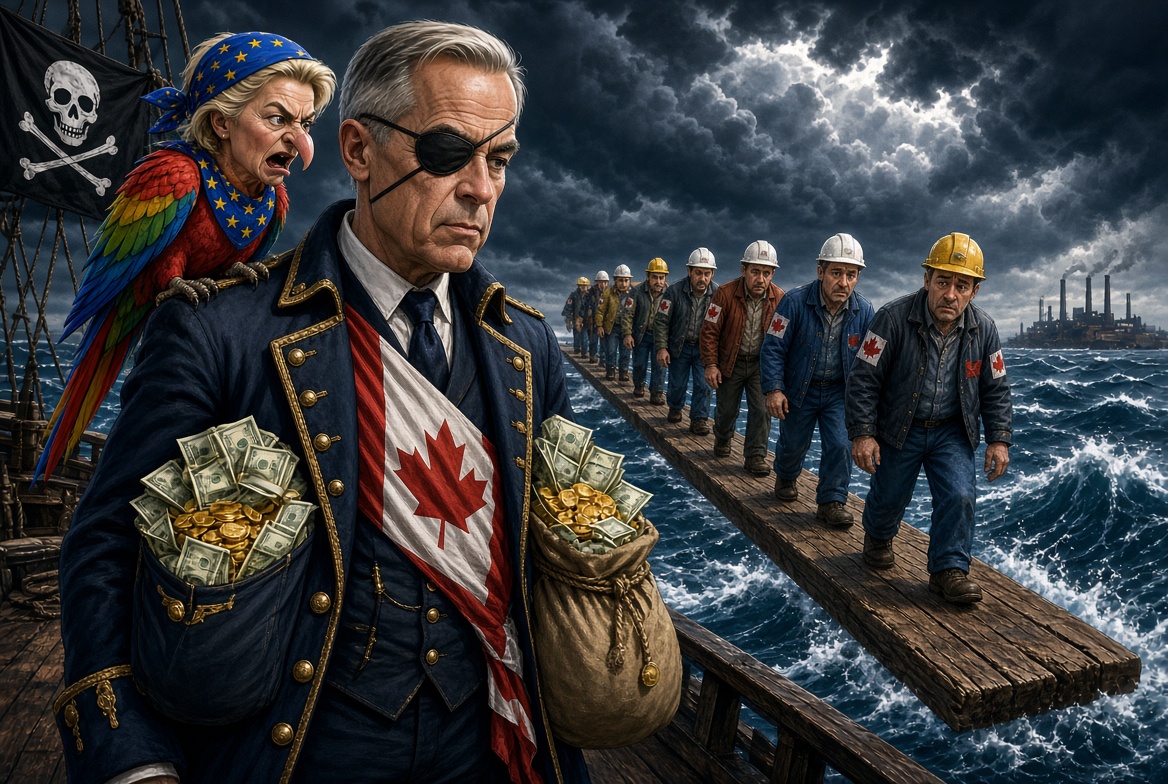
Call the process North American Uncoupling—or, if you want the personalities, the Carney–von der Leyen substitution. Canada is trying to replace a continental market and security architecture with a transatlantic political club plus a guarded China commercial thaw, while its factories vote with their feet. That is not a pirate’s plank in the cartoon sense. It is a slow walk off a well-signed trade relationship into a thinner set of alternatives, with Alberta already holding a referendum and manufacturers already booking U.S. floor space.
The plank is made of tariffs, treaty language both sides now treat as optional, and a bet that Brussels and Beijing can offset Detroit and Houston. The data so far say they cannot.
So will Canada follow Carney off the pirates’ plank into the depths of financial collapse, and more offshoring into fiscal dependency on the EU and China? That does not seem like a leader looking out for Canada. Just saying.
Making Appendices Great Again
Appendix: Sources and links
- https://www.politico.eu/article/ursula-von-der-leyen-state-of-the-union-europe-independence-ai-climate/
- https://www.bbc.co.uk/news/articles/cjwyzrr9d3dko
- https://www.reuters.com/world/americas/eu-head-call-european-solidarity-top-challenges-closer-canada-ties-2026-09-16/
- https://www.cbc.ca/news/world/eu-canada-associate-member-9.7345827
- https://www.politico.eu/article/eu-capitals-mark-carney-ursula-von-der-leyen-associate-membership-canada/
- https://www.theguardian.com/world/2026/sep/16/von-der-leyen-mark-carney-canada-eu-first-associate-member
- https://www.nytimes.com/2026/09/16/world/europe/eu-canada-associate-member.html
Canada–China defense talks
- https://www.theglobeandmail.com/canada/article-canada-first-defence-coordination-talks-china-more-than-eight-years/
- https://thehub.ca/2026/09/10/canada-promised-guardrails-against-china-why-is-it-reopening-military-talks/
- http://eng.mod.gov.cn/2025xb/N/T/16483829.html
- https://www.scmp.com/news/china/diplomacy/article/3366477/canada-and-china-thaw-continues-militaries-hold-first-talks-8-years-amid-us-pressure
Manufacturing, tariffs, jobs
- https://www.zerohedge.com/geopolitical/manufacturers-set-move-production-out-canada-us-tariffs-hit-hard
- https://kpmg.com/ca/en/media/2026/07/canadian-manufacturers-eye-us-production-move.html
- https://theworlddata.com/canada-manufacturing-statistics/
- https://www.cbc.ca/news/business/trade-war-by-the-numbers-9.7318683
- https://nationalpost.com/news/canada/tariffs-canadian-job-losses
- https://www.bbc.co.uk/news/articles/c4g4r4lxx25o
- https://www.cbc.ca/news/business/trade-renegotiation-impact-report-9.7303374
USMCA / CUSMA dispute
- https://www.cbc.ca/news/politics/mark-carney-counter-tarrif-response-9.7316934
- https://apnews.com/article/canada-trump-carney-trade-war-tariffs-4620ffb5ecc029322217207fa6758431
- https://www.politico.com/news/2026/08/22/us-canada-trade-deal-01046788
- https://www.congress.gov/crs-product/IN12734
Alberta referendum
- https://en.wikipedia.org/wiki/2026_Alberta_independence_referendum
- https://abacusdata.ca/alberta-at-a-crossroads-two-thirds-will-vote-to-stay-and-a-vote-to-proceed-is-not-a-vote-to-leave/
- https://www.elections.ab.ca/elections/referendum/
- https://www.cbc.ca/news/canada/calgary/alberta-second-referendum-timing-9.7341997
NATO spending and U.S. posture
- https://www.turkiyetoday.com/world/nato-defense-spending-projected-to-top-18t-in-2026-3223488
- https://www.statista.com/statistics/584035/defense-expenditures-of-nato-countries/
- https://fullfact.org/world/us-nato-contributions/
- https://www.cfr.org/articles/in-ankara-europe-faces-an-accelerating-u-s-decoupling-from-nato
- https://nationalsecurityjournal.org/if-america-walked-away-from-nato-the-biggest-loss-wouldnt-be-soldiers-it-would-be-the-eyes-and-ears-of-the-alliance/
- https://www.brookings.edu/articles/how-can-a-europeanized-nato-defend-europe-with-reduced-american-support/
- https://www.foreignaffairs.com/united-states/crumbling-defense-europe
GDP comparisons

