

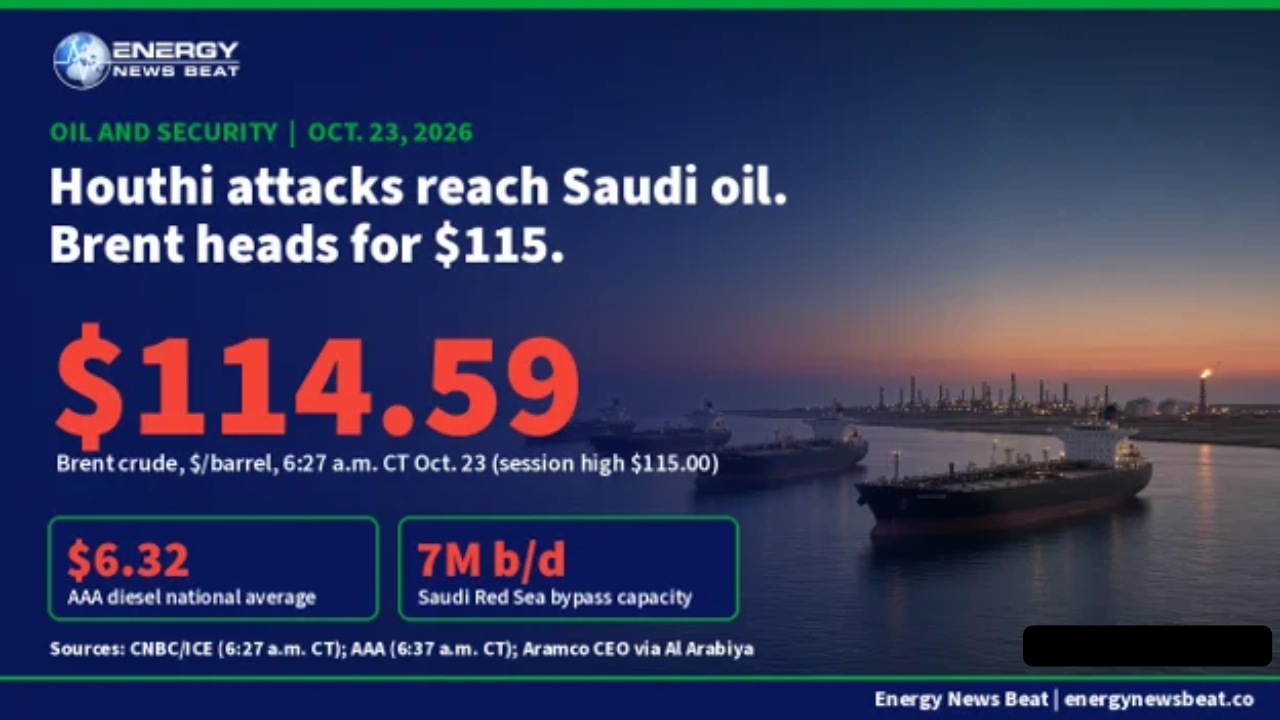
Iran claims seven tankers were hit near Hormuz, and President Trump calls the hits fake. Saudi Arabia’s Red Sea bypass is rated at 7 million barrels a day. Diesel is $6.32. Here is what is confirmed, what is only claimed, and what it costs you.
By Energy News Beat | Friday, Oct. 23, 2026 | Futures as of 6:27 a.m. CT (CNBC quote time; may be delayed); pump prices as of 6:37 a.m. CT; attack status as of 6:30 a.m. CT
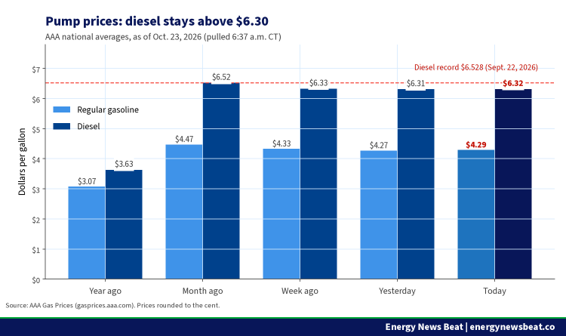
If you filled a diesel pickup or a farm truck this week, you already know the number: $6.32 a gallon, AAA’s national average this morning, up from $3.63 a year ago. Regular is $4.29, against $3.07 last October. A 30-gallon diesel fill runs about $189.52, roughly $80.57 more than a year ago (ENB calculation).
The reason is half a world away. Brent crude, the global benchmark, was $114.59 a barrel at 6:27 a.m. CT Friday, up +1.42 from Thursday’s $113.17 settle, after touching $115.00 overnight. U.S. crude (WTI) was $100.96. Brent jumped 4.0% Thursday and is at its highest since early May (CNBC; Reuters via Euronext).
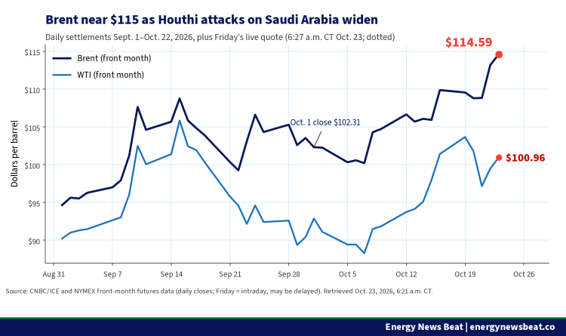
This updates our Oct. 18 weekly on Hormuz mines and refinery fires. Brent is up about $4.73 from its Oct. 16 close of $109.86 (ENB calculation), and the fight has moved from the Strait of Hormuz into Saudi Arabia’s oil heartland.
What happened, and what is only claimed
| Confirmed vs. claimed, as of 6:30 a.m. CT Oct. 23 | |
| Confirmed | Aramco told staff to evacuate Dhahran HQ (Reuters, six sources; Gulf News, citing three sources). Company did not comment. |
| Confirmed | Drone aimed at Shaybah intercepted Oct. 21; debris killed 2, injured 2; operations unaffected (Saudi Energy Ministry). |
| Confirmed | One tanker hit by an “unknown projectile” off Bukha, Oman, Oct. 21; fire out, crew safe (UKMTO). |
| Claimed | Iran: 4 ships struck, 3 hit mines near Hormuz (IRGC via Tasnim). President Trump calls them fake. |
| Claimed | Houthis: attacks on Aramco sites at Yanbu and Saudi defense ministry. Not confirmed by Saudi Arabia. |
| Stated | Aramco: East-West pipeline capacity 7M b/d (from ~2M), studying 10M (CEO to Al Arabiya). |
| Sources: Reuters, Gulf News, Saudi Energy Ministry, UKMTO, CNBC, CBS, Al Arabiya. Energy News Beat | energynewsbeat.co | |
Aramco’s headquarters. Aramco told staff to leave its Dhahran headquarters and work remotely, six people with knowledge of the matter told Reuters Thursday, in what Reuters called the first such evacuation of the Iran war. The company did not comment. Gulf News, citing three sources, said most staff had worked remotely since a Houthi strike on the building last week. Saudi stocks fell 2.5% (Reuters via ThePrint).
Shaybah. On Wednesday, Saudi air defenses shot down a drone aimed at a processing plant at the Shaybah field, which can produce about 1 million barrels a day (Bloomberg via World Oil). Debris set a contractor’s vehicle on fire, killing a Filipino and a Nepali worker and injuring two others. The Energy Ministry said operations were not affected (Saudi Gazette; Arab News). So Shaybah was targeted, but Riyadh says the field was not hit.
More strikes. A Houthi attack on the airport near Dhahran killed two people Wednesday, and the Houthis say they struck Aramco sites at Yanbu, the Red Sea export port. Saudi Arabia has not confirmed Yanbu (Reuters via ThePrint).
Hormuz. Iran’s Revolutionary Guard said four ships were struck and three hit mines, per Iran’s Tasnim agency (CNBC). President Trump wrote that Iran is “making up fake hits, mines, and everything else, because more Oil is coming through the Hormuz Strait now than it did even prior to the beginning of the Conflict” (CNBC). ENB found no independent confirmation of seven ships. The UK’s maritime agency did confirm one tanker struck by an “unknown projectile” off Oman on Oct. 21, with crew safe (UKMTO).
Why prices rise while oil keeps moving
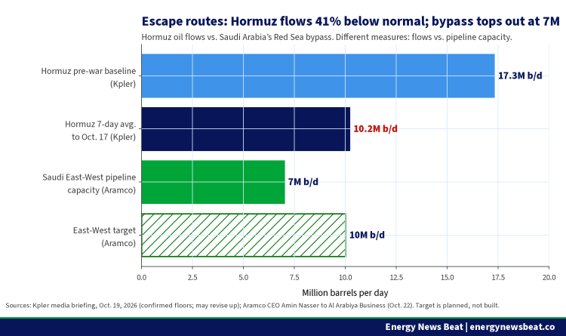
Both sides have a point. In its public Oct. 19 briefing, ship-tracker Kpler put the seven-day average through Hormuz, to Oct. 17, at about 10.2 million barrels a day, 41% below its pre-war baseline of 17.3 million. Adding Gulf of Oman terminals and the Red Sea, regional flows were 19% below baseline. Kpler calls these confirmed floors that usually revise upward. A newer Kpler figure reported Friday by the Wall Street Journal (paywalled; ENB could not independently verify it) put Hormuz 26% below pre-war, and said Middle East supply outside Iran is reaching markets above pre-war levels. Either way, oil is getting out, much of it by other routes.
Saudi Arabia’s main other route is the East-West pipeline to the Red Sea. Aramco CEO Amin Nasser told Al Arabiya Business its capacity has grown from about 2 million barrels a day to 7 million, and Aramco is studying 10 million (WSJ). That growth spans decades since the 1980s; the line reached 7 million back in March. It also ends at Yanbu, the port the Houthis now say they are targeting.
The market is also pricing time. U.N. Ambassador Mike Waltz told the Financial Times the war could still be going a year from now. “One would hope that they’ll come to the table in a meaningful way before that,” he said (CBS News).
What it means at your pump
Brent at $114.59 is about $2.73 a gallon of crude before refining, freight or taxes (ENB calculation). Diesel futures were $4.96 a gallon. Pump prices lag. From yesterday, regular is up 2.2 cents and diesel is up 0.8 cents. From a week ago, regular is down 3.4 cents and diesel is down 0.9 cents. Diesel sits 21 cents under its $6.53 record of Sept. 22. A 15-gallon tank of regular costs about $64.39, versus $46.07 a year ago (ENB calculation). Crude moves usually reach the pump over days to weeks.
Consumer and investor views
“The diesel is killing the business,” Danny Bui, an independent truck driver at the Port of Oakland, told KQED this week. “I would give it until the end of this year. If not, then I’ll have to find something else to do.” Charlotte trucker Avante Jackson told Fox News Digital this month: “If I’m putting all of my profit in the tank, at the end of the day, what do I have left to keep the doors open?”
UC Berkeley economist Severin Borenstein told KQED: “If I were a trucker, I would certainly not count on diesel prices getting back to pre-war levels any time in the next many months, possibly more than a year.” UBS analyst Giovanni Staunovo said “the market remains concerned about a potential escalation,” and XS.com’s Linh Tran said, “If attacks persist and delay deliveries, elevated prices will have a firmer foundation” (Reuters via Euronext).
| Stu’s Take
The number I keep coming back to is $6.32. That is what diesel costs this morning, and it is what moves groceries, crops and every package on a truck. Brent at $114.59 tells me it is not coming down soon. The President is right that more oil is moving than the headlines suggest. Even with Hormuz running 41% below normal, Kpler’s regional count is only 19% below once the bypass routes are added. But the market is not paying for today’s barrels. It is paying for the chance a drone gets through at Yanbu or at Shaybah’s 1 million barrels a day. When Aramco sends its own people home, traders notice. Saudi Arabia built a 7 million barrel-a-day back door over 40 years, and thank goodness. But that pipe cannot replace a strait that moved 17.3 million barrels a day before the war. If Ambassador Waltz is right that this could run another year, America needs to keep its own refineries running, keep its pipelines moving and quit treating domestic oil and gas like the enemy. If you run a fleet or a farm, I would talk to your fuel supplier now, and I would watch Yanbu, not the talk. Opinion. Stu Turley is the host of the Energy News Beat podcast. Figures linked to their sources. |
Caveats and the other side
- The President may be partly right. Gulf oil outside Iran is reaching markets above pre-war levels, and the seven ship hits are unconfirmed. Iran gains from fear and higher prices.
- Shaybah was not hit, says Riyadh. Headlines saying the Houthis “hit” Shaybah go further than the official record.
- “Under $97 at the start of October” needs a footnote. AP wrote that Brent rose from less than $97 at the start of the month (AP). CNBC data show an intraday low of $96.55 on Oct. 1, but a close of $102.31, and no October close below $100.20. On closes, Brent is up about 12% since Oct. 1 (ENB calculation).
- 7 million is capacity, not this week’s flow. Aramco did not publish a current flow figure.
- Futures are not pump prices. Taxes and local markets matter; California diesel runs about $2 over the national average (KQED).
What to watch
- Saudi or Aramco word on Yanbu, and whether Dhahran staff go back.
- Any UKMTO or U.S. Navy confirmation, or denial, of Iran’s seven-ship claim.
- Brent’s weekly close today, and the Nov. 3 midterms, which both sides now tie to these prices.
