

If the latest Colorado Public Utilities Commission findings surprised anyone, they have not been watching the grid. On September 26, 2026, The Denver Post reported that Xcel Energy’s Colorado customers are losing power more often and for longer periods than they did from 2015 through 2023—and that the pattern continued through the first half of 2026. Commission staff said customers experienced an above-average number of outages in every single month of 2024, 2025, and the first six months of 2026.
Amy Cooke put the policy question bluntly on X: Colorado regulators have investigated Xcel’s worsening reliability for two years, still cannot explain why outages remain elevated, and customers keep paying more. That is the regulated-monopoly bargain—captive customers in exchange for reliable service at reasonable rates. In Colorado, customers are getting neither.
The Colorado story is not isolated. Across the country, two different failure modes are stacking up. One is distribution-level and wildfire-driven shutoffs—Public Safety Power Shutoffs (PSPS) and chronic feeder outages. The other is resource adequacy risk—too little firm generation when heat, cold, wind drought, and plant outages hit at once. The first is already visible on customer bills and outage maps. The second is showing up as Energy Emergency Alerts, federal emergency orders, and CEO warnings that rolling blackouts could arrive as soon as 2027.Colorado: more outages, longer outages, still no “why.” Xcel serves about 1.6 million electric customers in Colorado. PUC staff found that in 2024 the average customer was without power for about 350 minutes—nearly six hours—versus a 2015–2023 average of 166 minutes. Outage minutes stayed above historical averages in the first half of 2026. Fifteen of the worst-performing feeders, just 2% of the system, accounted for 33% of outage minutes in 2025. Seven of those feeders were in Boulder.
Wildfire operations explain part of the jump, but not all of it. In December 2025, after the National Weather Service issued Colorado’s first “particularly dangerous situation” red-flag warning along the Front Range, Xcel ran PSPS events on December 17 and 19. Tens of thousands lost power; some businesses were dark through the weekend. Black Hills Energy ran its first Colorado PSPS in February 2026. Xcel has a $1.85 billion 2025–2027 wildfire plan aimed at making shutoffs smaller, shorter, and rarer. The PUC investigation still concludes that even after accounting for wildfire operations, outages remain above the historical trend.
Generation is tightening at the same time. Comanche Unit 3 has been offline since August 2025. Commissioners have flagged summer 2026 resource adequacy concerns. On July 20, 2026, Southwest Power Pool’s western balancing authority—including Colorado—escalated from Energy Emergency Alert Level 1 to Level 3 in 29 minutes, one step short of directed load shed, because of heat, generation outages, and low wind and solar output. SPP did not order rolling blackouts that day. It came close.
That combination—aging overhead distribution, wildfire liability, coal-plant outages, and a growing share of weather-dependent generation—is why Colorado is being conditioned to treat outages as normal. They are not supposed to be.
How big is the national problem?
It is not 2001 California or February 2021 Texas—yet. NERC’s 2026 State of Reliability report says the bulk power system still performed reliably in 2025. The same report says the margin for error is shrinking. Conventional generator weighted equivalent forced outage rates rose to 9.2% in 2025, above the historical 7–8% band. Coal units accounted for 39.8 TWh of additional unavailable energy; combined-cycle gas added 19.1 TWh. Deployable reserves are falling as plants age, cycle harder, and retire faster than firm replacements arrive.
NERC’s 2025 Long-Term Reliability Assessment found 13 of 23 assessment areas face resource adequacy challenges over the next decade. Summer peak demand across assessment areas is forecast to rise by more than 224 GW over 10 years. Data centers, electrification, and manufacturing are the load drivers. Interconnection queues are long. Transmission is slower than load growth. Inverter-based resources and large electronic loads introduce new operational risks: sudden 1,000–3,800 MW load trips when data centers switch to backup power.
The honest scale today:
- Widespread, multi-hour rolling blackouts from generation shortfalls remain rare in most of the Lower 48.
- Near-misses are no longer rare. SPP hit EEA-3 in July 2026.
- PJM used emergency procedures and DOE Section 202(c) orders during 2026 heat.
- Exelon’s CEO said the company came close to curtailing about 400,000 customers last winter.
- Planned shutoffs are becoming a Western operating tool, not a one-off California experiment.
- Distribution reliability is deteriorating in specific territories even when the bulk system holds.
That is a bigger problem than a single bad storm. It is a planning and policy problem.
Five utilities and regions to watch
1. Xcel Energy — Colorado (and a multi-state footprint)
The PUC record is the clearest recent regulatory admission that reliability is moving the wrong way while rates rise. Xcel also operates in Minnesota, the Dakotas, Texas, and New Mexico.
Colorado is the flashpoint because of PSPS, mountain-and-Front Range feeders, and SPP West tightness. Customers on a handful of bad circuits are absorbing a disproportionate share of the pain.
2. PG&E — Northern and Central California
PG&E remains the template for PSPS. The scale is down from the 2019 peak of roughly 2 million customers de-energized, but the tool is still in regular use. In 2025 PG&E ran multiple PSPS events, including January and June episodes. In 2026 it de-energized about 4,256 customers across eight counties on June 10–11 and ran another event around July 15. Southern California Edison continues the same practice. California ISO’s 2026 summer assessment shows a healthier resource stack than in 2020 or 2022, but wildfire-driven distribution shutoffs are independent of that surplus. Customers can have “enough generation” and still sit in the dark because a utility cut a line to limit ignition risk.
3. Exelon utilities in PJM — ComEd, BGE, PECO and affiliates
Exelon is the largest U.S. utility by customer count, about 10–11 million meters. CEO Calvin Butler told the Financial Times in June 2026 that Americans could “absolutely” lose power as soon as 2027 because of a plant shortage in the Northeast and Midwest. PJM’s last capacity auction cleared about 6.5–6.8 GW short of its reliability requirement. PJM has projected a multi-decade supply gap driven by data centers and retirements, and it is building a “reliability backstop” procurement plus rules that could curtail large loads—mainly data centers—before residential rolling blackouts. DOE issued 202(c) emergency orders in summer 2026 to keep plants and backup generation available. This is the largest interconnected market in the country. If PJM has to shed load, it will not be a local story.
4. Dominion Energy — Virginia and the world’s largest data-center cluster
Northern Virginia is the stress test for large-load integration. On July 22, 2026, a routine 230-kV fault in Dominion’s zone caused about 3,800 MW of data-center load to trip to backup power—the largest such event in PJM history. System load dropped roughly 3.8% in minutes. Dominion has tens of gigawatts of data-center requests in the pipeline against a system peak near 25 GW. PJM is now talking about ride-through standards because these loads disconnect too easily. The risk here is two-sided: not enough supply for the new load, and the new load itself destabilizing the grid when it drops off.
5. Rocky Mountain Power / PacifiCorp — Utah, Wyoming, Idaho, Oregon
Rocky Mountain Power initiated PSPS in southern Utah in late June 2026, with about 7,735 customers in the event footprint and more than 18,000 in the broader watch/warning area under extreme wildfire conditions. PacifiCorp’s Oregon reliability filings show emergency de-energizations as a distinct outage category. This is the California playbook moving inland: overhead lines, dry fuels, legal liability, and preemptive shutoffs. Add SPP and WECC tightness in the Interior West, and the same customers face both planned shutoffs and regional energy emergencies.
Honorable mention: MISO-region utilities (Ameren, Entergy, and others). NERC still flags MISO as a longer-term high-risk area if additions lag demand and retirements. MISO South has already seen localized load-shed and transmission emergencies. The 2026 summer assessment called near-term risk “normal,” with risk rising later in the decade.
What the pattern actually means
Rolling blackouts are not “the new normal” everywhere. They are becoming a designed operating procedure in fire-prone West and a planning risk in PJM, MISO, SPP West, and parts of the Rockies.
Three drivers keep showing up in the official reports:
- Firm capacity is leaving faster than firm capacity is arriving. Coal and some gas units are old, forced-outage rates are up, and replacements are often solar, wind, and four-hour batteries that do not cover multi-day wind droughts or winter peaks.
- Load is growing again, after two decades of flat demand. Data centers are the sharp edge. Electrification of heat and transport adds a slower, broader ramp.
- Liability and vegetation politics are changing distribution operations. Utilities now turn the grid off to avoid starting fires. That protects against Camp Fire-scale catastrophe. It also means customers experience blackouts on purpose.
The Colorado PUC’s inability to answer “why” after two years matters because the same incentives exist nationwide. Utilities earn a return on capital. Reliability metrics are often treated as a compliance afterthought. Worst feeders stay worst. Maintenance gets deferred. Regulators investigate after the outage minutes have already doubled.
Customers are then told to buy generators, shift load, and accept PSPS as public safety. That may be rational for a single wind event. It is not a substitute for a grid with enough dispatchable generation, hardened lines, and a regulatory compact that actually delivers the reliability customers were promised.
The near-term outlook is more emergency alerts, more targeted shutoffs, higher rates, and a rising chance that some regions cross from “we almost shed load” to “we did.” Colorado is not the whole country. It is an early, well-documented example of the same bargain breaking down.
So this weekend I did a test in both homes. One in Texas, where I ran my freezer and calculated out resources, and then again in the other office location on Sunday.
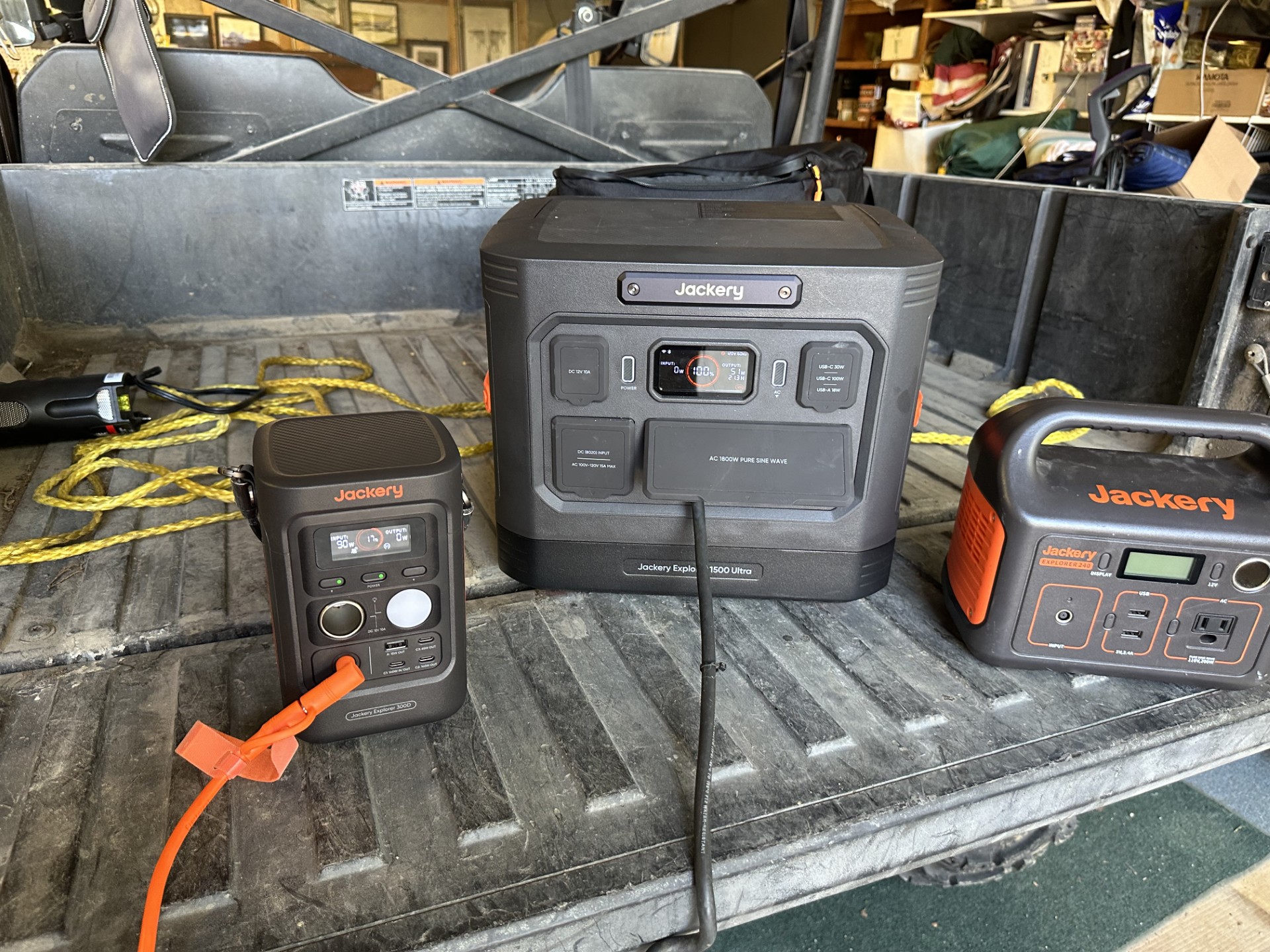
I did a dry run for a grid outage and made some notes. The Jackery I have at each location will work great, and I’ll include configurations and recommendations in future articles. I highly recommend a Jackery HomePower 3000 Portable Power Station. It is bigger than the one shown below because it has the home connection. The one shown below is the Jackery Explorer 1500 Ultra and ran freezers just fine. Couple either one with good solarpanels, and a gas generator, and you are off and running.
The HomePower 3000 is $1,349; budget for $1,799 for two solar panels, and another set of extension cables for a couple of hundred. We have several types of Generators depending on what jobs we are working on, and we have propane or gasoline generators and are not 100% off-grid capable yet, but we would be comfortable for extended time periods. I will be saving up for this one as I still need one more with a few more panels.
Also pictured below is a new Jackery Explorer 3000, and I love this little guy. Already having Jackery solar panels, this coupled with a cigarette lighter plug for 110 shown in the Ranger Bed, makes this worth it. It is around $189. Flexible, and it works great with my laptop. In a remote podcast in an oilfield, I only need the two smaller units, and I can run my laptop and Starlink without carrying big gear.
One other thing: for my setup in Abilene, I bought Jackery-branded solar panels, and there is a significant difference in quality between off-brand and the Jackery ones I just bought. I will share a more detailed comparison and the advantages. Not all solar panels are created equal. Jackery is the only large manufacturer in this space that has never had a recall. That, to me, is a huge selling point in a disaster. Having good gear makes all the difference in a life-or-death scenario.
The bottom line – Blackouts are coming, Blackouts are coming- is a bit of a joke, but as we saw the Iranians try to attack the B1S in the UK this morning, how many Iranian cells are in the US is a real question. Toss on the data center issues and the warnings from our great utilities, and we have a recipe for interesting times ahead.
Making Appendices Great Again
Check out the World’s Greatest Podcast Show Notes at EnergyNewsBeat.co or EnergyNewsBeat.com.
Appendix: Sources and links
Colorado / Xcel
- Amy Cooke, X post, Sept. 27, 2026: https://x.com/TheRightAOC/status/2104066079194833235
- The Denver Post, “Xcel Energy’s Colorado power outages are getting worse, and regulators want answers,” Sept. 26, 2026: https://www.denverpost.com/2026/09/26/xcel-power-outages-colorado/
- Denver Gazette, Xcel $1.85B wildfire / PSPS plan, April 1, 2026: https://www.denvergazette.com/2026/04/01/xcel-says-1-85b-plan-aims-to-make-public-safety-power-shutoffs-rarer/
- Independence Institute, “Southwest Power Pool narrowly avoids blackouts,” July 23, 2026: https://i2i.org/southwest-power-pool-narrowly-avoids-blackouts/
- Rocky Mountain Voice, July 20 SPP West EEA-3 recap, Aug. 10, 2026: https://rockymountainvoice.com/2026/08/10/colorado-utilities-said-a-regional-grid-would-strengthen-reliability-july-20-tested-it/
- Complete Colorado, “Coloradans being conditioned to blackouts as normal,” Jan. 9, 2026: https://completecolorado.com/2026/01/09/coloradans-conditioned-blackouts-new-normal/
- City of Boulder PSPS FAQ: https://bouldercolorado.gov/public-safety-power-shutoffs-and-related-outages-frequently-asked-questions
- Engage DORA customer comments / investigation summary: https://engagedora.org/customer-response
National reliability assessments
- NERC 2026 State of Reliability (overview): https://www.nerc.com/newsroom/2026-State-of-Reliability-Report
- NERC 2025 Long-Term Reliability Assessment: https://www.nerc.com/globalassets/our-work/assessments/nerc_ltra_2025.pdf
- NERC 2026 Summer Reliability Assessment: https://www.nerc.com/globalassets/our-work/assessments/nerc_sra_2026.pdf
- Utility Dive, “Deployable reserves shrinking as coal, gas forced outage rates rise: NERC,” June 25, 2026: https://www.utilitydive.com/news/deployable-reserves-shrinking-forced-outage-rates-increase-nerc/823765/
PJM / Exelon / Dominion
- Financial Times, Exelon CEO Calvin Butler blackout warning, June 27, 2026: https://www.ft.com/content/14d2e591-7cd5-4456-904f-1b7fdc5cbc1a
- Reuters, PJM reliability backstop and data-center demand, July 28, 2026: https://www.reuters.com/business/energy/largest-us-power-grid-moves-ahead-with-plan-meet-swelling-demand-2026-07-28/
- Utility Dive, PJM 3.8 GW data-center trip, Aug. 12, 2026: https://www.utilitydive.com/news/pjm-nerc-data-center-crypto-reliability-standards/827653/
- DOE emergency order materials (PJM 202(c)), June 2026: https://www.energy.gov/documents/doe-order-no-202-26-33
- Pennsylvania PUC-related resource adequacy discussion: https://www.puc.pa.gov/media/4044/2026_assessing_electricity_resource_adequacy_in_pa_and_pjm.pdf
California / PG&E / SCE
- Sacramento Bee, PG&E June 2026 PSPS, June 11, 2026: https://www.sacbee.com/news/local/article316092908.html
- PG&E PSPS restoration update, June 11, 2026: https://www.pge.com/en/newsroom/currents/safety/pg-e-monitoring-weather-that-could-prompt-targeted-power-shutoff.html
- CPUC PSPS post-event reports (PG&E June 10–11, 2026 and SCE June 26, 2026): https://www.cpuc.ca.gov/
- CAISO 2026 Summer Loads and Resources Assessment: https://www.caiso.com/generation-transmission/resource-adequacy/2026-summer-loads-and-resources-assessment
Rocky Mountain Power / SPP
- Rocky Mountain Power PSPS initiation, June 26, 2026: https://www.rockymountainpower.net/about/newsroom/news-releases/rmp-initiates-public-safety-power-shutoffs-utah.html
- Reuters, SPP warns of potential rolling blackouts, July 21, 2026: https://www.reuters.com/business/energy/grid-operator-us-central-states-warns-potential-rolling-blackouts-2026-07-21/
Live outage trackers (point-in-time)
- Colorado: https://usoutage.com/colorado/
- Xcel Energy: https://usoutage.